Bra Size Calculator – Find Your Perfect Bra Size Online
Finding the right bra size can make a big difference in everyday comfort and support. Our free Bra Size Calculator helps you estimate your bra size using two simple measurements: your underbust and bust.
Whether you are shopping for a new bra, checking your current size, or learning how to measure yourself at home, this calculator provides a helpful starting point.
Enter your measurements, select your preferred unit, and get an estimated bra size along with related sister sizes. You can also use our measurement guide and international size charts to understand your results.
Please note: Bra sizing varies between brands and countries. Your calculator result is an estimate, so always check the individual brand’s size guide and try the bra on when possible.
Free Bra Size Calculator
Use the calculator below to estimate your bra size based on your body measurements.
Bra Size Calculator
Sister Sizes
International Size Conversion
| US | UK | EU |
|---|
This is an estimated size. Bra sizing varies by brand, style and country. Check the brand’s size chart and try the bra on to confirm the fit.
How to Use the Bra Size Calculator
Follow these simple steps:
- Select your measurement unit: inches or centimeters.
- Measure your underbust, directly below your breasts.
- Measure your bust around its fullest part.
- Enter both measurements into the calculator.
- Select your preferred sizing system: US, UK, or EU.
- Click the Calculate My Bra Size button.
Your estimated band size and cup size will appear along with suggested sister sizes.
How Our Bra Size Calculator Works
The calculator uses your underbust and bust measurements to estimate a starting bra size.
The underbust measurement helps determine the band size, while the difference between the bust and the relevant band reference helps estimate the cup size.
Different sizing systems use different measurement conventions and cup-letter sequences. For this reason, the calculator should use a documented regional sizing chart rather than treating one formula as universal.
The result is a starting recommendation, not a guarantee of a perfect fit.
How to Measure Your Bra Size at Home
You do not need professional equipment to measure your bra size. A flexible measuring tape and a few minutes are usually enough.
For a more reliable measurement, stand naturally with your shoulders relaxed. Ideally, take your measurements while wearing a non-padded bra or without a bra.
1. How to Measure Your Underbust
Your underbust measurement is the circumference around your rib cage, directly beneath your breasts.
Follow these steps:
- Place a flexible measuring tape around your rib cage, just below your breasts.
- Keep the tape straight and level around your back.
- Make sure it feels snug without restricting your breathing.
- Record the measurement in inches or centimeters.
This measurement helps estimate your bra band size.
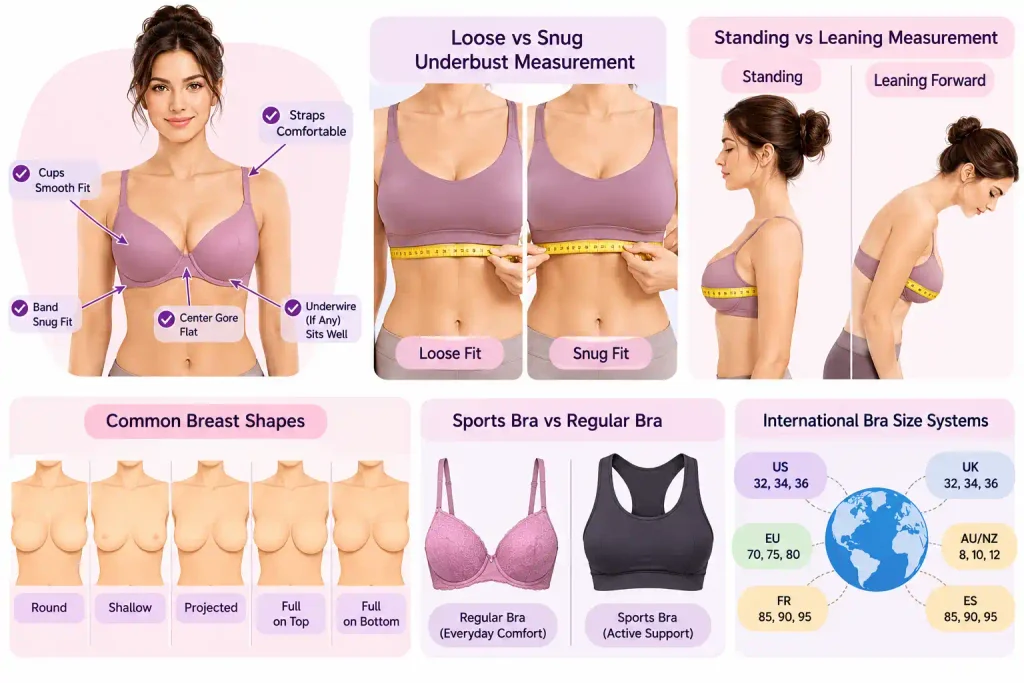
2. How to Measure Your Bust
Your bust measurement is taken around the fullest part of your breasts.
Follow these steps:
- Wrap the measuring tape around the fullest part of your bust.
- Keep the tape level across your back.
- Make sure the tape is not too tight or compressing your breasts.
- Record the measurement without pulling the tape firmly.
This measurement is used alongside your underbust measurement to estimate your cup size.
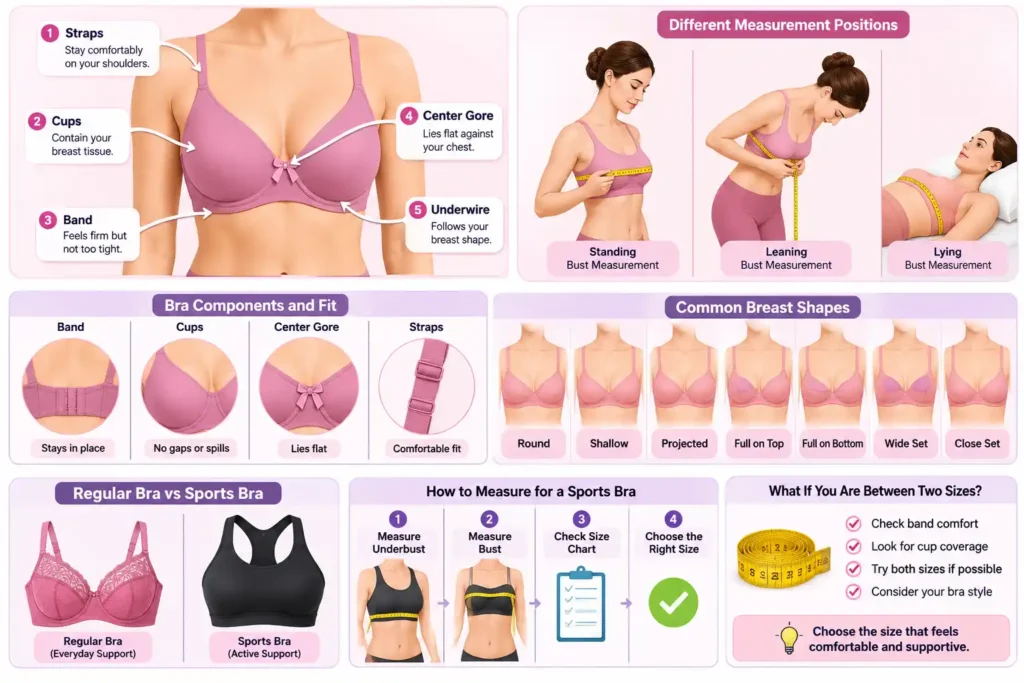
3. How to Measure With a Measuring Tape Correctly
For better results:
- Use a flexible fabric measuring tape.
- Stand straight and keep your body relaxed.
- Keep the tape parallel to the floor.
- Avoid measuring over thick clothing.
- Record both measurements accurately.
- Repeat the measurements if you are unsure.
4. How to Measure in Inches and Centimeters
You can use either inches or centimeters.
If your measuring tape shows inches, select inches in the calculator. If it shows centimeters, select centimeters.
For reference:
1 inch = 2.54 centimeters.
Do not mix measurement units when entering your measurements.
5. Common Bra Measurement Mistakes to Avoid
Avoid these common mistakes:
- Measuring over thick clothing.
- Pulling the measuring tape too tightly.
- Allowing the tape to slope across your back.
- Measuring above or below the correct bust position.
- Using an old measurement without checking it again.
- Assuming every brand follows the same sizing chart.
Taking accurate measurements is the first step toward finding a more comfortable bra.
Understanding Different Bra Measurements
Finding a suitable bra size involves more than taking a single measurement. Your underbust and bust measurements provide a starting point, but understanding how your measurements change with tape tension and body position can help you evaluate your fit more carefully.
Different measurement approaches can provide additional information about your body and help you understand why a calculated size may not always feel comfortable.
Loose vs. Snug Underbust Measurement
Your underbust measurement is taken around your rib cage, directly below your breasts. However, the measuring tape can produce slightly different readings depending on how firmly you hold it.
Two useful approaches are:
- Loose underbust: Place the tape around your rib cage without pulling it tightly. It should rest comfortably against your skin.
- Snug underbust: Wrap the tape firmly around your rib cage while keeping it comfortable and allowing you to breathe normally.
These measurements help you understand the difference between a relaxed measurement and a closer-fitting band measurement.
For example, if your loose measurement is slightly larger than your snug measurement, this is normal because the tape applies different levels of tension.
Why does this matter?
A bra band should feel secure without restricting your breathing or causing discomfort. Comparing these measurements can help you understand your preferred band feel when trying different bras.
Remember that your calculator may require only one standard underbust measurement. Do not enter an average of loose and snug measurements unless the calculator specifically instructs you to do so.
Standing vs. Leaning Bust Measurement
Your bust measurement can vary depending on your body position and how your breast tissue naturally sits.
Two positions can help you understand these differences:
Standing bust measurement
Stand naturally with your shoulders relaxed. Keep the measuring tape around the fullest part of your bust, making sure it stays level across your back.
Leaning bust measurement
Bend forward slightly at the waist and allow your breasts to fall naturally. Take the measurement around the fullest part without compressing the tissue.
When is leaning measurement useful?
Some breast shapes have tissue that sits differently when standing compared with leaning forward. Comparing the two positions can provide additional information when evaluating cup coverage and bra style.
However, not every sizing system uses leaning measurements. Your standard calculator result should continue to follow the measurement method and formula specified by the calculator.
When Should You Take New Bra Measurements?
Your bra size is not necessarily fixed throughout your life. Body measurements can change due to several factors.
Consider checking your measurements again when:
- You experience noticeable weight gain or weight loss.
- You are pregnant or have recently given birth.
- You are breastfeeding or have recently stopped breastfeeding.
- You notice changes during different stages of life.
- Your current bras no longer feel comfortable.
- Your usual bra size starts fitting differently.
You do not need to wait for a particular date if your current bra is already uncomfortable.
A practical approach is to recheck your measurements when you notice a change or before purchasing new bras if your previous size no longer fits.
Understanding Bra Band Size and Cup Size
A bra size generally consists of two parts: a number and a letter.
For example, in 34B:
- 34 represents the band size.
- B represents the cup size.
Both measurements work together to determine the overall bra size.
What Is Band Size?
Band size refers to the measurement around your rib cage, directly below your breasts.
The band provides much of the support of a bra. It should fit securely around your body without riding up or causing discomfort.
A band that is too loose may move around, while one that is too tight may feel restrictive.
What Is Cup Size?
Cup size describes the approximate difference between your bust measurement and the relevant band reference.
Common cup labels include:
AA, A, B, C, D, DD, DDD, E, F, and G.
However, the exact cup-letter progression varies between sizing systems.
Cup size is also relative to band size. A 34C and a 36C do not represent exactly the same cup volume.
How Are Band Size and Cup Size Different?
Band size determines the number in your bra size, while cup size determines the letter.
For example:
- 32B has a smaller band than 34B.
- 34C has a larger band and cup volume than 32C.
- 34D and 36D have different cup volumes despite sharing the same cup letter.
This is why you should consider both measurements when choosing a bra.
Bra Size Chart – Bra Size Calculator
The following table provides a basic reference for common US and UK band and cup labels.
Common Bra Band Sizes
| US/UK band | Approx. EU band |
| 30 | 65 |
| 32 | 70 |
| 34 | 75 |
| 36 | 80 |
| 38 | 85 |
| 40 | 90 |
| 42 | 95 |
| 44 | 100 |
| 46 | 105 |
| 48 | 110 |
Common Cup Sizes
| US cup label | UK cup label |
| AA | AA |
| A | A |
| B | B |
| C | C |
| D | D |
| DD | DD |
| DDD | E |
| F | F |
| G | G |
| H | H |
These are simplified reference conversions. Some brands use different cup progressions, particularly at larger sizes. Always check the manufacturer’s conversion chart before purchasing.
US, UK, and EU Bra Size Conversion
International bra sizing can be confusing because countries do not always use the same band numbers or cup letters.
The following table provides commonly used approximate conversions.
International Band Size Conversion
| US | UK | EU |
| 30 | 30 | 65 |
| 32 | 32 | 70 |
| 34 | 34 | 75 |
| 36 | 36 | 80 |
| 38 | 38 | 85 |
| 40 | 40 | 90 |
| 42 | 42 | 95 |
| 44 | 44 | 100 |
| 46 | 46 | 105 |
| 48 | 48 | 110 |
International Cup Size Conversion
| US | UK | EU |
| AA | AA | AA |
| A | A | A |
| B | B | B |
| C | C | C |
| D | D | D |
| DD | DD | E |
| DDD | E | F |
| F | F | G |
| G | G | H |
| H | H | I |
Important: This is a simplified conversion reference based on commonly published charts. Cup-letter equivalence is not universal. For example, some manufacturers use different labels for the same approximate cup volume. French, Spanish, Australian, and other regional systems may also require separate conversions.
Always confirm your size against the brand’s own chart.
What Are Sister Sizes? – Bra Size Calculator
Sister sizes are bra sizes with approximately similar cup volume but different band sizes.
When you increase the band size, you generally need to decrease the cup letter to maintain a similar cup volume. When you decrease the band size, you generally need to increase the cup letter.
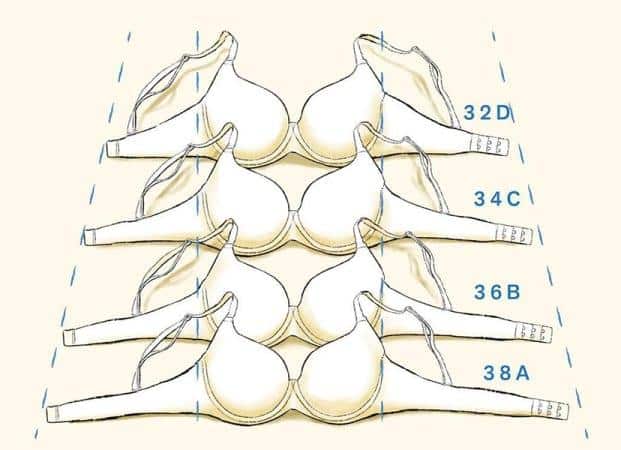
Sister Size Examples
| Original size | Smaller band | Larger band |
| 32C | 30D | 34B |
| 34C | 32D | 36B |
| 36C | 34D | 38B |
| 34D | 32DD | 36C |
| 36D | 34DD | 38C |
For example, 34C and 36B are sister sizes. The 36B has a larger band but approximately similar cup volume to the 34C.
When Should You Try a Sister Size?
Consider trying a sister size when:
- Your band feels too tight but the cups fit.
- Your band feels too loose but the cups fit.
- You want to compare different band options.
- Your usual size is unavailable.
Sister sizes are useful alternatives, but they do not guarantee the same fit across different bra styles or brands.
Signs You Are Wearing the Wrong Bra Size
An incorrectly fitting bra may cause discomfort, poor support, or visible fitting problems.
Here are some common signs to look for.
1. Your Bra Band Rides Up
If the back of your bra moves upward, the band may be too loose.
Try a smaller band size while checking whether the cup size also needs adjustment.
2. Shoulder Straps Dig Into Your Skin
Shoulder straps should not carry all the support.
If they dig into your shoulders, check whether your band is providing enough support. You may also need to adjust the straps.
3. Your Cups Are Overflowing
If breast tissue spills over the top or sides of your cups, the cups may be too small or the bra shape may not suit your breast shape.
Try a larger cup size or a different style.
4. There Are Gaps Inside the Cups
Empty space inside the cups may indicate that the cups are too large or that their shape does not match your breast shape.
Try a smaller cup or a different cup design.
5. The Underwire Causes Discomfort
The underwire should sit around the breast tissue rather than pressing into it.
If it pokes or digs into your skin, try a different cup size or bra style.
6. The Band Feels Too Tight or Too Loose
A properly fitted band should feel secure and stay level around your body.
If it is too tight, try a larger band. If it rides up or moves around, try a smaller band.
Always check the cup fit when changing the band size.
How to Check If Your Bra Fits Properly
Knowing your calculated bra size is only the first step. A bra should also fit your body correctly when you wear it.
Two people with the same calculated size may prefer different bra styles because cup shape, wire placement, fabric and construction can affect the overall fit.
Use the following checkpoints to evaluate your bra.
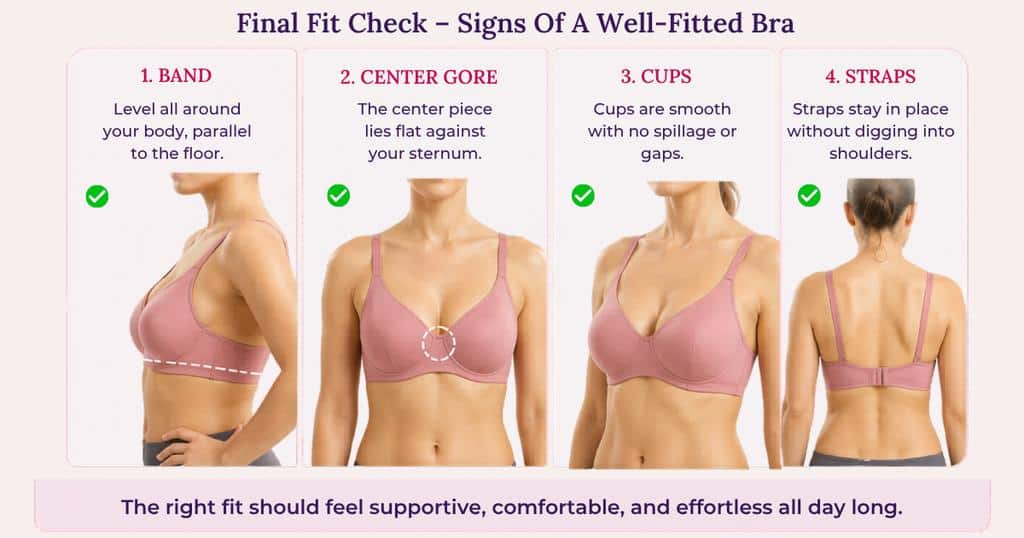
How Should the Bra Band Fit?
The band is an important part of bra support because it anchors the bra around your rib cage.
A properly fitting band should:
- Sit horizontally around your torso.
- Feel firm without causing pain or restricting breathing.
- Stay in place when you move your arms.
- Avoid riding up toward your shoulder blades.
- Allow comfortable movement throughout the day.
When trying a new bra, start with the loosest hook setting if the design allows it. This leaves room to tighten the band as the elastic stretches with regular use.
If the band repeatedly rides up your back, it may be too loose. However, check the cup fit before changing sizes because an unsuitable cup can also affect how the band sits.
How Should Bra Cups Fit?
Bra cups should contain your breast tissue without creating excessive gaps or pressure.
Check the following:
- Your breast tissue should not spill over the top or sides.
- The cup fabric should not have large empty spaces or persistent wrinkles.
- The cup should follow the natural shape of your breast.
- The underwire, if present, should sit around the breast tissue rather than directly on it.
- You should be able to move comfortably without the cup shifting excessively.
If the cups feel too small, consider trying a larger cup size. If they have persistent gaps, another cup size or a different cup shape may be more suitable.
Not every fitting issue requires changing the size. Sometimes the design of the bra is the actual problem.
What Is the Center Gore and How Should It Fit?
The center gore is the small section of fabric that connects the two cups at the front of an underwired bra.
In many traditionally fitted underwire bras, the center gore should rest against the chest between the breasts.
Check whether:
- The center section rests comfortably against your chest.
- It does not sit on top of breast tissue.
- It does not cause painful pressure.
- It remains reasonably stable when you move.
If the center gore floats away from your chest, the cup may be too small, the band may be too large, or the bra’s construction may not suit your body.
Some plunge bras, wireless bras and other designs are intentionally constructed differently. Therefore, the center gore test should be considered alongside the bra’s style.
How Should Bra Straps Fit?
Bra straps help keep the cups positioned correctly, but they should not carry all the weight of the bra.
For a comfortable fit:
- Adjust both straps so they stay on your shoulders.
- Avoid tightening them until they dig into your skin.
- Make sure they do not repeatedly slip off.
- Check that the cups remain in the correct position.
- Adjust the straps individually if your shoulders need slightly different lengths.
If you constantly need to tighten your straps to lift the cups, check the band and cup fit as well.
How to Test Your Bra Fit Through Movement
A bra may look suitable while you are standing still but move out of position during everyday activities.
After putting on your bra, perform a few simple movements:
- Raise both arms above your head.
- Bend forward slightly.
- Rotate your upper body from side to side.
- Walk around normally.
- Sit down and stand up again.
Observe whether the band stays in place, the cups maintain coverage and the straps remain comfortable.
If the bra shifts significantly, causes pressure or repeatedly needs adjustment, try another size or design.
A suitable bra should remain comfortable during normal movement rather than only looking correct in front of a mirror.
How Body Shape Affects Bra Size and Fit
Your calculated bra size provides a useful starting point, but breast shape and tissue distribution can influence how a particular bra fits.
Two people wearing the same bra size may have different fitting experiences because their breast shapes, spacing and fullness are not necessarily identical.
Understanding these differences can help you choose a bra design that feels more comfortable.
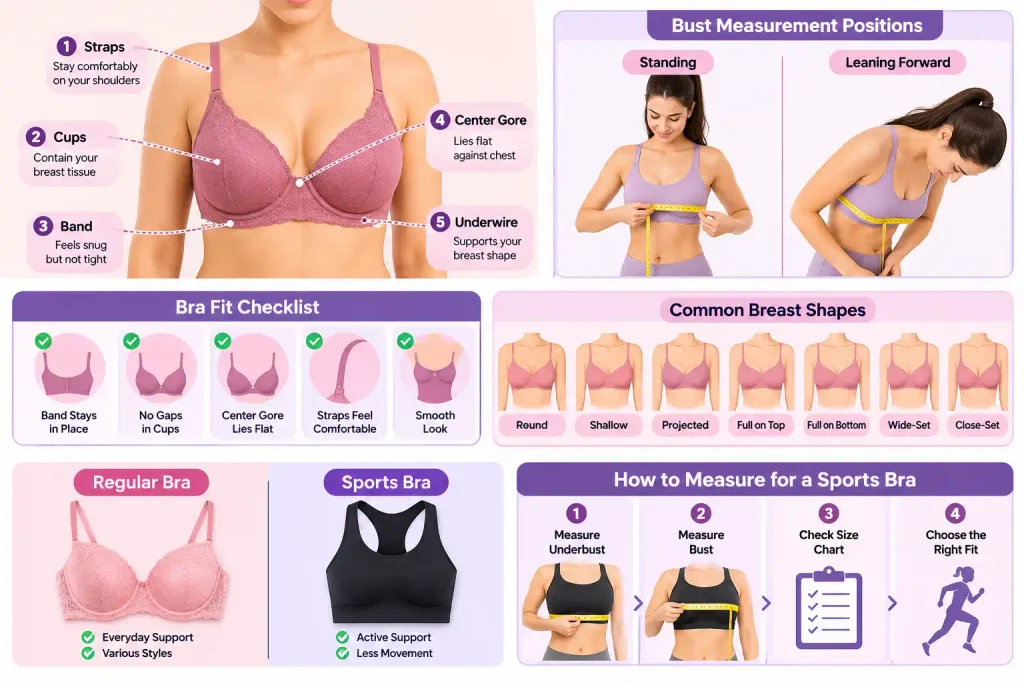
How Breast Shape Affects Bra Fit
Breast shape describes how breast tissue is naturally distributed across the chest.
Some common shape characteristics include:
- Round: Breast fullness is distributed relatively evenly across the upper and lower portions.
- Shallow: Breast tissue has a wider base with less forward projection.
- Projected: Breast tissue extends further forward from the chest.
- Full on top: More fullness is present in the upper portion of the breast.
- Full on bottom: More fullness is present in the lower portion.
- Close-set: The breasts naturally sit closer together.
- Wide-set: There is more space between the breasts.
These are general fit characteristics, not strict categories. A person may have a combination of different characteristics.
How can shape influence bra selection?
- A projected shape may need cups with more forward depth.
- A shallow shape may feel more comfortable in cups designed with a wider base.
- Fullness distribution can affect whether the upper part of a cup gaps or feels tight.
- Breast spacing can influence the comfort of the center section and underwire placement.
The goal is not to change your natural shape. It is to find a bra construction that works with your body.
How Breast Tissue Can Affect Cup Fit
Breast tissue can vary in firmness, density and distribution. These characteristics may influence how the same cup design feels on different people.
For example:
Softer tissue: Breast tissue may spread differently inside a cup, making coverage and cup construction important.
Firmer tissue: A structured cup may feel different because the tissue maintains its shape more readily.
Uneven breast volume: One breast may naturally be slightly larger than the other. In this situation, choosing a cup that comfortably accommodates the larger breast can help prevent unwanted pressure.
These are general fitting considerations rather than a method of calculating cup size.
A measuring tape cannot determine tissue density or fully describe breast shape. This is one reason why a calculator result should be followed by an actual fit assessment.
Why the Same Bra Size Fits Differently in Different Bras
A bra size label does not describe every detail of the bra’s construction.
Different manufacturers may use different patterns, fabrics, cup shapes and size grading methods.
Even within one brand, a padded bra, plunge bra and full-coverage bra may feel different in the same labeled size.
Here are some factors that can affect fit:
| Bra feature | How it affects fit |
| Cup depth | Determines how much forward space the cup provides |
| Cup width | Affects how the cup covers breast tissue |
| Underwire shape | Influences how the wire follows the breast root |
| Padding | Changes the internal space available in the cup |
| Fabric stretch | Affects how closely the bra follows your body |
| Band construction | Influences how securely the bra stays in place |
This is why your usual bra size should be treated as a starting reference rather than a guarantee that every design will fit identically.
Tips for Finding the Right Bra Size
Use these practical tips when choosing your next bra:
- Measure yourself before purchasing a new bra.
- Check your measurements in the brand’s own size chart.
- Make sure the band stays level around your body.
- Check that the cups fully contain your breast tissue.
- Adjust the shoulder straps for comfortable support.
- Try different bra styles because cup shapes can vary.
- Consider sister sizes if your usual size does not feel comfortable.
- Recheck your measurements after noticeable body changes.
- Try a bra on and move around to assess comfort.
- Remember that comfort and fit are more important than the size printed on the label.
What If You Are Between Two Bra Sizes?
Sometimes your measurements may fall between two sizes on a brand’s chart. This does not automatically mean that your measurements are incorrect.
Sizing charts use defined measurement ranges, while individual bodies and bra designs do not always fit neatly into those ranges.
Choosing the Right Option Between Two Sizes
If you fall between two sizes, consider the following:
1. Evaluate your band comfort
If the band feels excessively tight even when the cups fit correctly, try a larger band and an appropriately adjusted cup size.
If the band rides up or moves around, a smaller band may be worth trying.
2. Check your cup coverage
If breast tissue spills over the top or sides, consider a larger cup.
If the cups have excessive empty space, try a different cup size or shape.
3. Consider the bra material
A bra with flexible fabric may feel different from a rigid, heavily structured design.
Stretch fabrics can accommodate small variations in body shape, while structured cups may require a closer match.
4. Compare the brand’s size chart
Always check the individual manufacturer’s sizing information. A measurement that falls between sizes in one brand may correspond to a standard size in another.
Tips for a Comfortable Fit Between Sizes
Use these practical tips when comparing two possible sizes:
- Try both sizes if they are available.
- Check the band and cups separately.
- Avoid choosing a size simply because it is smaller or larger.
- Test the bra while sitting, standing and moving.
- Consider a different cup style if neither size feels comfortable.
- Use sister sizes as an additional option when appropriate.
For example, if you normally wear 34C, the commonly used sister sizes are 32D and 36B.
However, sister sizes are not guaranteed to fit identically because changing the band also changes the overall proportions of the bra.
The most suitable option is the one that provides comfortable coverage, a stable band and suitable support.
Sports Bra vs. Regular Bra Sizing
Sports bras and regular bras are designed for different activities. Although both provide breast support, their construction and sizing systems can differ.
A regular bra is generally designed for everyday wear, while a sports bra is designed to help limit breast movement during physical activity.
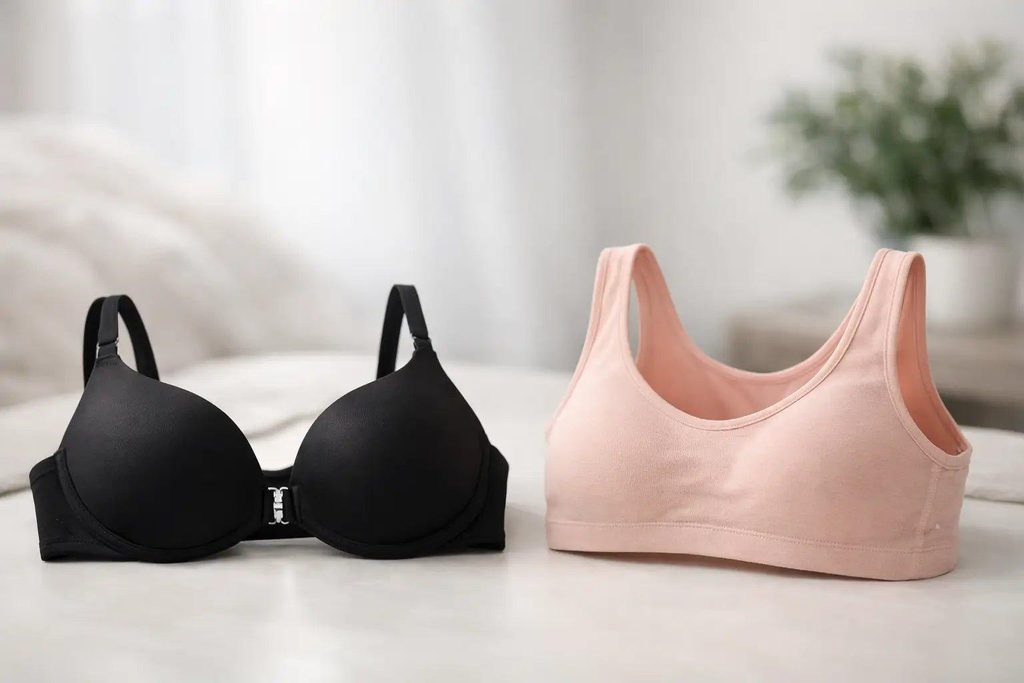
What Is the Difference Between Sports Bras and Regular Bras?
| Feature | Regular bra | Sports bra |
| Main purpose | Everyday comfort and support | Support during physical activity |
| Construction | Different cup and band designs | Compression, encapsulation or combined construction |
| Sizing | Often band and cup sizes | Band/cup or XS to plus-size labels |
| Coverage | Varies by bra style | Often designed for more secure coverage |
| Movement | Everyday activities | Designed to manage movement during exercise |
Sports bras generally use three common support approaches:
Compression sports bras
These use fabric pressure to hold breast tissue closer to the body. They are commonly available in pull-on designs.
Encapsulation sports bras
These have separate cups that support each breast individually.
Combination sports bras
These combine compression and individual cup construction to provide support through both methods.
The best design depends on the activity, body measurements and personal comfort.
How to Measure for a Sports Bra
Start with the measurement instructions provided by the sports bra manufacturer because different brands may use different sizing systems.
For a traditional band-and-cup sports bra, the usual measurements include:
Step 1: Measure your underbust
Place a flexible measuring tape directly below your breasts. Keep it level around your body and comfortably snug.
Step 2: Measure your bust
Measure around the fullest part of your bust without compressing the breast tissue.
Step 3: Record both measurements
Write down your measurements using the unit required by the manufacturer’s chart.
Step 4: Check the brand’s sports bra chart
Compare your measurements with the manufacturer’s size guide.
Some brands convert traditional band-and-cup sizes into XS, S, M, L, XL or plus-size categories. Do not assume that these labels are identical across brands.
How to Choose a Sports Bra for Different Activities
Different physical activities involve different levels of movement.
Low-impact activities
Examples include walking, stretching and gentle yoga. A comfortable, flexible sports bra may be suitable.
Medium-impact activities
Activities such as cycling, strength training and faster-paced workouts may require more stable support.
High-impact activities
Running, jumping and intense cardio involve more breast movement. A sports bra with secure construction and suitable coverage is generally a better starting point.
Your personal comfort, measurements and the manufacturer’s support recommendations should guide your final choice.
Finding Bras for Less Common Sizes
Not every brand offers the same range of band and cup sizes. Some people may find that their calculated size is not available in a particular store or collection.
This does not mean that their measurements are incorrect.
How to Find Bras Outside Standard Size Ranges
If your calculated size is difficult to find, consider these steps:
- Look for brands that offer extended band sizes.
- Check whether the manufacturer provides fuller-cup options.
- Compare the brand’s actual size chart instead of relying only on its product labels.
- Explore different bra styles and cup constructions.
- Check whether the manufacturer offers sister sizes as alternative options.
Some specialist lingerie brands offer more combinations of band and cup sizes than general clothing retailers.
What to Consider When Shopping for Extended Sizes
When choosing a bra outside a brand’s standard size range, pay attention to its construction.
- Band width: A wider or differently constructed band may provide a more comfortable fit.
- Cup depth: Check whether the cups have sufficient space for your breast shape.
- Strap construction: Adjustable and appropriately positioned straps can improve comfort.
- Underwire design: The wire should follow the breast root without pressing into breast tissue.
- Size availability: Check whether the brand offers your band and cup combination rather than only a general size category.
A size should never be selected only because it is the closest option available. Comfort and fit remain the main considerations.
Understanding Australian and New Zealand Bra Sizes
Bra size labels can differ between countries. This can make online shopping confusing, particularly when a brand uses Australian or New Zealand sizing rather than US, UK or EU labels.
Australian Bra Size System
Australian bra sizing commonly uses band numbers such as 8, 10, 12, 14 and 16.
These numbers are different from the band numbers commonly used in US and UK sizing.
For example, an Australian size label may look like 12B or 14C.
When shopping from an Australian brand, use its official measurement and conversion chart rather than directly entering an Australian band number into a US or UK size chart.
New Zealand Bra Size System
New Zealand retailers commonly use Australian-style band labels, including 8, 10, 12 and 14.
However, individual brands may have their own fitting recommendations and product-specific sizing charts.
If you are purchasing from a New Zealand retailer, check whether its size guide uses Australian-style measurements or another sizing convention.
French and Spanish Bra Size Systems
French and Spanish bra sizing generally uses a different band-number convention from US and UK sizing.
For example, French and Spanish size labels may include numbers such as 85, 90, 95 and 100.
These numbers should not be confused with EU band labels, even when they appear similar.
The exact conversion should be checked using the manufacturer’s regional size chart.
Important: International bra sizing is not completely standardized. Cup letters, band references and conversion methods can vary between manufacturers. Always verify the specific brand’s chart before purchasing.
Frequently Asked Questions About Bra Size Calculator
1. How do I calculate my bra size at home?
Measure your underbust directly below your breasts and your bust around its fullest part. Enter both measurements into a bra size calculator to receive an estimated band and cup size.
2. How do I measure my bra size without a measuring tape?
You can use a non-stretch piece of string to measure around your underbust and bust. Mark the lengths and compare them with a ruler or measuring stick. Make sure the string is not stretched or pulled too tightly.
3. What is the easiest way to find your correct bra size?
The easiest starting point is to measure your underbust and bust, then use a bra size calculator. Check the result against the manufacturer’s size chart and assess the fit when wearing the bra.
4. How do I calculate my cup size?
Cup size is estimated using the difference between the bust measurement and the relevant band reference. The difference is then compared with a regional or brand-specific cup chart.
5. What is the difference between bust size and band size?
Bust size measures around the fullest part of your breasts. Band size relates to the circumference around your rib cage directly beneath your breasts.
6. How do I measure my underbust?
Place a flexible measuring tape directly below your breasts and around your rib cage. Keep it level across your back and snug without restricting your breathing.
7. Can I calculate my bra size in centimeters?
Yes. You can measure your underbust and bust in centimeters and use a calculator that accepts metric measurements. Make sure both measurements use the same unit.
8. What is a sister size in bras?
A sister size has approximately the same cup volume but a different band size. For example, 34C and 36B are sister sizes in commonly used sizing systems.
9. How do I convert US bra sizes to UK sizes?
Start by converting the band and cup separately. Band numbers are often the same in US and UK sizing, but cup letters can differ, particularly above DD. Always use the specific manufacturer’s conversion chart.
10. How often should I measure my bra size?
Recheck your measurements when your body changes noticeably, when your current bras stop fitting comfortably, or when you are shopping for a new bra. There is no single schedule that works for everyone.
11. How do I know if my bra is too small?
Common signs include breast tissue spilling out of the cups, an uncomfortable band, underwire pressing into breast tissue, or difficulty fastening the bra comfortably.
12. How do I know if my bra is too big?
A band that rides up, straps that repeatedly slip, or cups with persistent empty space may indicate that your bra is too large or that its shape is unsuitable.
13. Does bra size change with age or weight changes?
Bra size can change over time because of body-weight changes, pregnancy, breastfeeding, hormonal changes, and natural body development. Rechecking your measurements can help you identify a better starting size.
14. Are bra sizes the same across all brands?
No. Brands may use different measurement methods, size ranges, cup progressions, and designs. A size that fits well in one brand may feel different in another.
15. Can a bra size calculator give an accurate result?
A bra size calculator can provide a useful starting estimate based on your measurements. However, it cannot account for every factor, including breast shape, bra design, fabric, and brand-specific sizing. Always check the actual fit.
16. What Is the Difference Between Loose and Snug Underbust Measurements?
A loose underbust measurement is taken with the measuring tape resting comfortably around your rib cage without pulling it tightly. A snug underbust measurement is taken with the tape held firmly but without restricting your breathing. Comparing both measurements can help you understand how different band tensions may feel. Always enter the measurement requested by your bra size calculator rather than averaging the two.
17. Does Leaning Forward Change Your Bust Measurement?
Yes. Your bust measurement may change when you lean forward because breast tissue moves naturally with your body position. A standing measurement records your bust in its normal upright position, while a leaning measurement provides additional information about breast tissue distribution. Not every bra sizing method requires both measurements, so follow the instructions provided by your calculator.
18. Can Breast Shape Affect My Bra Size and Fit?
Yes. Breast shape can influence how a particular bra fits, even when two people have the same calculated size. Differences in breast fullness, projection, spacing and tissue distribution can affect cup coverage and comfort. A calculator estimates your size from measurements, but trying different cup shapes can help you find a more suitable fit.
19. What Is a Center Gore in a Bra?
The center gore is the section of fabric connecting the two cups at the front of an underwired bra. In many traditional underwire designs, it should rest comfortably against your chest between your breasts. If it lifts away or presses painfully against breast tissue, the cup size, band size or bra design may need to be reconsidered.
20. How Do I Know Which Sports Bra Size to Choose?
Start by measuring your underbust and bust, then compare both measurements with the sports bra manufacturer’s size chart. Some sports bras use traditional band and cup sizes, while others use labels such as XS, S, M, L and XL. Because sizing varies between brands, always follow the specific manufacturer’s fitting instructions.
21. Should I Wear a Different Bra Size for Exercise?
Not necessarily. Your regular bra size can provide a starting reference, but sports bras may use different sizing systems and construction. Choose a sports bra that provides suitable support for your activity, stays securely in place and allows comfortable movement. Check the manufacturer’s size guide rather than automatically choosing a larger or smaller size.
22. How Do Australian and New Zealand Bra Sizes Differ from US and UK Sizes?
Australian and New Zealand bra sizing commonly uses band numbers such as 8, 10, 12 and 14, while US and UK systems generally use numbers such as 32, 34 and 36. These labels follow different sizing conventions. Use a verified regional conversion chart or the manufacturer’s size guide when comparing sizes between countries.
23. Are French and Spanish Bra Sizes the Same as EU Sizes?
No. French and Spanish bra sizing generally uses different band-number references from standard EU sizing. For example, French and Spanish labels may include 85, 90 and 95, while EU labels commonly use 70, 75 and 80. Exact conversions can vary by manufacturer, so check the brand’s official international size chart before purchasing.
Final Thoughts
Finding a comfortable bra starts with understanding your measurements. Our free Bra Size Calculator helps you estimate your band and cup size using simple measurements.
Measure carefully, check the relevant size chart, and explore sister sizes when needed. Remember that the best bra size is the one that fits your body comfortably, not simply the one printed on the label.